
Why you can’t just Stop: Schema Therapy and Eating Disorders
Over the past few months, I have been doing further training and learning more about Schema Therapy and how it applies to eating disorders, and honestly, it has been incredibly powerful to witness in my work with clients. For many people, Schema Therapy has created those real “ah ha” moments where things suddenly start to make sense in a way they never have before.
Clients often come into therapy feeling frustrated and confused. They know their eating patterns are hurting them. They know they don’t want to binge, restrict, avoid food, emotionally eat, or stay trapped in obsessive thoughts around food and body image. Yet somehow, they keep finding themselves pulled back into the same behaviours over and over again. This can leave people feeling stuck, ashamed, or like they are “failing” as a person.
What schema therapy helps people understand is that these behaviours are often deeply ingrained coping strategies that developed for a reason. When people can understand why these patterns developed, they are much better able to shift away from them and start working with the underlying needs and emotions that have been fueling the eating disorder all along. For many people, this is the missing piece that finally helps recovery click.
What is Schema Therapy?
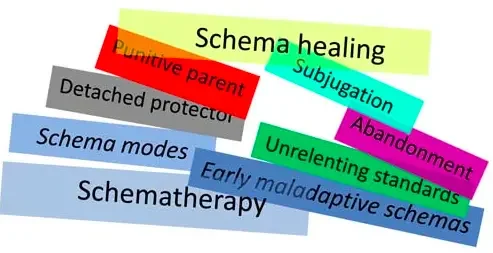
Schemas are core beliefs we hold about ourselves, others, and the world. When these schemas are triggered, they can lead to intense emotional distress and eating disorder behaviours often emerge as a way to cope. Schema Therapy is an evidence-based approach that helps us understand why patterns like disordered eating develop and persist. It focuses on deeply rooted emotional patterns (called schemas) that are often formed in childhood when core emotional needs were not fully met.
Rather than just addressing behaviours like binge eating, restriction, or food avoidance, schema therapy looks underneath these behaviours at the core beliefs, emotions, and coping strategies that drive them, because eating disorder behaviours are often deeply connected to emotional patterns that developed much earlier in life. For many people with eating disorders, these schemas are at the core of the struggle and Schema Therapy can offer a way to understand these patterns at a deeper level.
Common schemas in eating disorders include:
Defectiveness / Shame – “There’s something wrong with me”
Unrelenting Standards / Perfectionism – “I must be in control and get it perfectly right”
Emotional Deprivation – “No one truly understands me”
Abandonment / Instability – “People will leave me”
Vulnerability to Harm – “Something bad will happen if I’m not careful”
Insufficient Self-Control – “I can’t manage my impulses” (often linked with binge eating)
Unmet Emotional Needs in Childhood
At the core of schema therapy is the understanding that all children have basic emotional needs, including:
Safety and stability/security
Emotional connection and attunement
Autonomy and independence/competence
Freedom to express emotions and needs
Realistic limits and guidance
When these needs are not consistently met, schemas can develop. For example:
A child who felt criticised may develop shame and perfectionism
A child whose emotions were dismissed may disconnect from their internal cues (including hunger/fullness) and suppress their emotions
A child in an unpredictable environment may seek control through food or body
Schema therapy also looks at coping modes, which are the ways we adapt to painful schemas because when schemas are triggered, they trigger feelings such as defectiveness, shame and loneliness, which are incredibly painful and overwhelming. Eating disorder behaviours often function as coping modes, to help us deal with these overwhelming sensations. For example:
Defectiveness / Shame
A belief of being fundamentally flawed → may drive body dissatisfaction, secrecy, or binge eating/restrictionUnrelenting Standards / Perfectionism
A need to meet extremely high standards → rigid food rules, restriction, over-exercising, “all-or-nothing” thinking, obtaining the perfect body or dietEmotional Deprivation
A sense that your emotional needs won’t be met → turning to food for comfort or disconnecting from needs altogetherAbandonment / Instability
Fear of being left → using food or control as distraction or being ill so others won’t leave youInsufficient Self-Control
Difficulty tolerating distress → impulsive eating or chaotic patterns
These behaviours were once adaptive (they helped you cope in some way). However, coping modes provide short-term, temporary relief but in the long term, they reinforce the very schemas that drive them, keeping you stuck in the cycle.
How Food Freedom Coach Can Help you break out of the Disordered Eating Cycle for good
My approach integrates Schema Therapy with evidence-based eating disorder treatment (CBT, DBT and ACT) to support both behavioural change and deeper emotional healing.
Assessment
We begin with a comprehensive assessment to understand your eating patterns, schemas, coping modes, and maintaining factors. This helps us create a personalised formulation of what’s driving your relationship with food.
Education & Awareness
You’ll learn how your schemas and coping modes developed, and how they show up in your eating behaviours, thoughts, and emotions. This often brings a sense of clarity and self-compassion, knowing that coping modes are an act of survival.
Strengthening the “Healthy Adult”
A key goal of schema therapy is to build your Healthy Adult mode, the part of you that can:
Respond to emotional needs in a more direct, balanced and values-based way
Challenge harsh self-criticism (the “Inner Critic”)
Regulate emotions without relying on disordered eating behaviours
Make values-based decisions around food, relationships and getting your needs met
Practical and Behavioural Change
Alongside this deeper work, we use structured strategies for behavioural change, such as:
Normalise regular eating patterns
Reduce binge eating, purging, restriction, or avoidance of fear foods or uncomfortable situations
Build distress tolerance and emotional regulation skills
Reconnect with your hunger, fullness, and body cues by learning to trust your body again
